
The Basque Country: Where Spain Feels Like Another World

There's a moment, somewhere between Rioja and the coast, when the light changes. The earth turns from ochre to a deep mossy green, the road curves through pine and beech forest, and the first wooden farmhouse — a baserri, painted in deep red against whitewashed walls — appears on the hillside. The Basque Country announces itself quietly, but unmistakably. By the time you reach the sea, you understand you've crossed into somewhere that follows its own rules, speaks its own language, and feeds its people better than almost any region on earth.
I've been bringing American travelers through this region for more than two decades, and the reaction is almost always the same: a kind of cultural surprise. They expected Spain. They found something stranger and far more specific.
At a Glance:
- A Region That Stands Apart
- San Sebastián, Bilbao, and the Towns Between Them
- A Land Defined by Its Table
- Crafts, Sport, and a Living Heritage
- Practical Notes
- Beyond the Two Cities
- Frequently Asked Questions
A Region That Stands Apart
The Basque Country — Euskadi in the local tongue — sits in the far north of Spain, wedged between the Bay of Biscay and the Pyrenees, with one foot in France. Its language, Euskera, is unrelated to any other living language in Europe. Linguists have spent centuries trying to trace its origins and largely given up. What this means for the traveler is simple: you are visiting a culture that predates nearly everything else on the continent.
The land reflects that singularity. This is the greenest part of Spain — wet, mountainous, and Atlantic, with mist rising off the hills most mornings and a coastline of dramatic cliffs broken by fishing villages. Within a single hour you can move from a wild beach to a high mountain pass, and from there to a medieval town where men still play pelota against stone walls on weekend afternoons.
If you arrive expecting flamenco and sun-bleached plazas, recalibrate. This is a quieter, more reserved Spain — Atlantic rather than Mediterranean in its weather, its food, and its way of speaking.

San Sebastián, Bilbao, and the Towns Between Them
The Basque Country revolves around two cities that could not be more different in character, and the stretch of coast that links them. Understanding both — and the road between — is the whole architecture of a good visit. For travelers who want the full arc in a single private trip, our seven-day Basque package puts it together.
San Sebastián (Donostia)
San Sebastián is, by any reasonable measure, one of the most beautiful cities in Europe. La Concha bay curves in a perfect crescent against the city, the old town wraps tight around the church of Santa María del Coro, and every street seems to lead either to the sea or to a pintxos bar. The city holds more Michelin stars per capita than almost anywhere on earth, but its real culinary soul lives in the Parte Vieja — the old quarter — where you eat standing up, moving from bar to bar, ordering one perfect bite at a time.
The trick to the Parte Vieja is knowing which bar is famous for which thing. One does foie better than anywhere in Spain; another, three doors down, is known only for its grilled mushrooms; a third, almost hidden, serves the city's best txuleta. Without that map, an evening here is enjoyable. With it, it becomes one of those meals you remember for years. This is the kind of evening best done as San Sebastián private walking and pintxos tour, with someone who knows which bar does the foie best, which one to skip, and which to save for last.
I tell my clients to base themselves here for at least three nights. Climb Monte Urgull to the Castillo de la Mota for the view across the bay, swim at La Concha at midday, ride the funicular up Monte Igueldo at sunset, and spend the evenings in the old town with a txakoli in hand.
Bilbao
A generation ago, Bilbao was a declining industrial port. Then Frank Gehry's Guggenheim arrived in 1997, and the city reinvented itself. Today, it is the cultural capital of the Basque Country — confident, walkable, and architecturally extraordinary. The Guggenheim alone justifies a stay, though the building is only half the story. The collection inside makes far more sense with a guide who can frame what you're looking at — Gehry's titanium curves are only the introduction.
Beyond the museum, don't overlook the Casco Viejo, with its seven medieval streets, or the great covered market of La Ribera. The food in Bilbao tends to be heartier and less refined than in San Sebastián — bacalao al pil-pil, kokotxas, the famous Gilda pintxo of olive, anchovy, and pickled pepper. Two nights are enough; three if the museum holds you. Climb the long staircase up to the Basílica de Begoña before you leave — the patron saint of Bizkaia presides over the city from up there,and few visitors ever make the trip. For everything else the city offers, I've put together a full 48 hours in Bilbao.
The Coast Between Them
The hour-long road between Bilbao and San Sebastián is, in my experience, one of the most underrated drives in Europe. It curves past cliffs, fishing harbors, and small villages where life still follows the boats. Stop in Getaria, a stone village where the local restaurants grill whole turbot — rodaballo — over open coals at the harbor's edge. The wine here, txakoli, is poured from a height to aerate it, and the entire village smells faintly of charcoal and the sea. Cristóbal Balenciaga was born here, and the small museum dedicated to him is one of the most elegant in Spain.
Vitoria-Gasteiz and the Interior
Inland, Vitoria-Gasteiz — the official capital of the Basque Country — receives a fraction of the visitors of its coastal sisters and is the better for it. Its Catedral de Santa María, restored over decades and the inspiration for one of Ken Follett's novels, is an event in itself. The medieval old town is one of the best preserved in northern Spain, and the surrounding green plain, the Llanada Alavesa, is dotted with stone villages and Romanesque churches that almost no foreign traveler ever sees.

A Land Defined by Its Table
You cannot understand the Basque Country without understanding how its people eat. This is, by most measures, the gastronomic capital of Spain — and possibly of Europe. Food is not a topic of polite conversation here; it is the central organizing principle of social life.
Begin with the pintxos: small, often elaborate constructions served on bread or skewers, displayed along the bars of the old quarters. The traditional rhythm is to order one or two, drink a zurito — a small beer — or a glass of txakoli, and move on to the next bar. Three or four bars is a good evening. Five is ambitious.
Beyond pintxos, the region's table is built on the sea and the mountain. Order the bacalao al pil-pil, an emulsion of salt cod and its own gelatin, or the txuleta, an aged beef chop from a local baserri cow, served rare on a sizzling plate. In autumn, find a sagardotegi, one of the traditional cider houses outside the cities, where the year's new cider is poured straight from the barrel and dinner is served family-style around long wooden tables. Idiazabal cheese, raw sheep's milk and lightly smoked, ends every proper meal.

Crafts, Sport, and a Living Heritage
The Basques are makers. The txapela, the deep navy beret, is still hand-blocked in small workshops in Tolosa. The makila, a carved walking stick once carried by farmers as both staff and weapon, is now made by only a handful of artisans, each piece commissioned and personalized for the person who will carry it.
And then there is pelota, the regional sport, played in a frontón against a high stone wall — fast, noisy, and impossibly difficult. Every village has one. On Sunday afternoons, men in white shirts and red sashes still play in front of the local crowd, and watching a match for half an hour is one of the most quietly memorable experiences a visitor can have.

Practical Notes
Plan for at least four nights — five or six is better. Most clients I work with split their stay between San Sebastián and Bilbao, with at least one day given to the coast. The two cities are close enough that you can move easily, but each one deserves its own evenings.
Plan for at least four nights — five or six is better. Most clients I work with split their stay between San Sebastián and Bilbao, with at least one day given to the coast. The two cities are close enough that you can move easily, but each one deserves its own evenings. Many travelers extend the trip south into Rioja, which sits an hour from Bilbao — we arrange private intercity rides between the two regions for anyone who wants to combine both.
Beyond the Two Cities
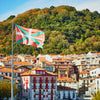
Beyond the well-known names, much of the best of the Basque Country sits off the main routes, in places most visitors never reach. The Urdaibai Biosphere Reserve, west of Bilbao, is a tidal estuary of marshes and small medieval towns, with Mundaka — a famous left-hand surf wave — at its mouth. Inland, Oñati and Bergara are working Basque towns of stone and shuttered balconies, with seminaries and university buildings that hint at the region's long intellectual life. Hondarribia, on the French border, is a walled medieval town painted in colors I've seen nowhere else in Spain.
These are the places where Euskera is heard most in the streets, and where the cider houses still feel like family kitchens.
To plan a private trip through the region, Contact us!
Frequently Asked Questions
What are three things that make the Basque Country unlike anywhere else in Spain?
First, an evening of pintxos in San Sebastián's Parte Vieja, moving bar to bar with a small glass in hand — there's nothing quite like it elsewhere in the country. Second, txakoli, the slightly fizzy white wine poured from a height into a thick tumbler, made only here. And third, the village of Getaria, where whole turbot is grilled over coals at the harbor's edge. Together they capture the region's intimacy with the sea, the table, and the street.
When is the best time to visit the Basque Country?
Late May through early October. June and September are my favorites — warm enough for the coast, calm enough for the restaurants. July and August are beautiful but crowded, particularly in San Sebastián during the film festival and Semana Grande.
How many days do I need in the Basque Country?
At least four nights to do it justice. Five or six is better — three nights in San Sebastián, two in Bilbao or along the coast. Less than that and you'll only scratch the surface — there's a lot packed into a small geography here.
Should I base myself in San Sebastián or Bilbao?
Both, if you can. If you can only choose one, San Sebastián for first-time visitors — the food, the beach, and the old town are an unbeatable combination. Bilbao is the better fit if you are traveling primarily for the art and architecture.
Do I need a rental car in the Basque Country?
Not strictly. The train between Bilbao and San Sebastián is fast, and both cities are walkable. But the coast and the interior villages are far easier with private transport. For travelers who want to see beyond the two main cities, I always recommend either a car or a private driver-guide.
Is the Basque Country a good fit for first-time visitors to Spain?
It can be, though it gives a very particular impression of the country — quieter, cooler, less Mediterranean. I usually suggest pairing it with a contrast: Madrid, Andalusia, or Barcelona. The Basque Country is unforgettable, but it is not representative of all of Spain.
What's the biggest mistake tourists make in the Basque Country?
Treating San Sebastián as a single-day stop, and arriving at the pintxos bars without any sense of which bar is known for what. The food culture only reveals itself after several evenings, and the right local guidance shortens that learning curve enormously.
Will I have trouble communicating in the Basque Country?
No. Spanish is widely spoken alongside Euskera, and English is common in tourist-facing places, especially in San Sebastián and Bilbao. Learning a few Basque words — eskerrik asko for thank you, kaixo for hello — earns warm responses, but is not necessary.
Is the Basque Country good for families?
Yes, particularly the coast. Children love the beaches at San Sebastián, the funicular up Monte Igueldo, the aquarium in the old port, and the food, which is approachable and varied. The region tends to be relaxed and welcoming with younger travelers.
Can I combine the Basque Country with other regions of Spain?
Easily. Rioja is just to the south — a natural pairing for wine and gastronomy lovers, and an extension we often arrange directly. Madrid is three hours away by high-speed rail. And the French Basque coast — Biarritz, Saint-Jean-de-Luz — is less than an hour from San Sebastián, making it simple to add a cross-border day or two.
Every article here reflects 25+ years on the ground—I've personally visited every destination, conducted the research, and taken these photos. AI helps us shape the writing and ensure clarity. The expertise? That's all mine.
- Carlos Galvin

Comments 0