
Andalusia Distilled: An Insider Guide to Spain's Most Captivating Corner

When American clients ask me where to begin their Spain experience, my answer is almost always the same: Andalusia. While Madrid and Barcelona are the essential urban gateways—the sophisticated 'must-sees' that introduce you to Spain’s modern energy—Andalusia is where the country’s heartbeat truly quickens.
It isn't necessarily because it’s the easiest region to visit—it’s not—but because nowhere else delivers such an intense, distilled concentration of history, culture, and human warmth in one place. In over 25 years of bringing American travelers through our Spain tours, I've watched first-timers arrive expecting flamenco and sunshine, and leave with something far more profound: a genuine understanding of how three civilizations — Muslim, Jewish, and Christian — built one of the most sophisticated cultures the medieval world had ever seen. Here is my insider guide to Andalusia's most essential regions.
At a Glance:
- Seville — The Soul of Andalusia
- Granada — Where the Moors Left Their Last Masterpiece
- Córdoba — Europe's Forgotten Capital
- The Pueblos Blancos — Andalusia's Most Photogenic Secret
- The Tastes of Andalusia
- The Craft of Andalusia
- Moving Between Cities — The Letango Way
- Plan Your Andalusia with Letango
Seville — The Soul of Andalusia
Most visitors to Seville spend their time in the obvious places — and for good reason. The Cathedral, the Giralda, the Alcázar. But the city reveals itself in layers. What many people don't realize is that the Torre del Oro — the golden tower on the Guadalquivir River — wasn't named for its color. It was the point where every ship arriving from the Americas had to register its cargo: gold, silver, spices, before it could enter the city. That tower witnessed the greatest transfer of wealth in human history. The Barrio de Santa Cruz, today a maze of charming lanes and flower-filled patios, was once the walled Jewish quarter of the city. And the Giralda, Seville's iconic bell tower? It was built as a minaret in 1198 — you can still see the original Moorish architecture if you know where to look. Our Seville Highlights Private Driving and Walking Tour covers both the grand boulevards and the intimate backstreets, so you leave understanding Seville, not just having photographed it.If you want to go deeper into the city before you arrive, my complete 48-hour guide to Seville covers everything from where to eat to what to notice that most visitors walk straight past

Granada — Where the Moors Left Their Last Masterpiece
Granada is the city that stays with you longest. The Alhambra is, of course, the reason most people come — and it deserves every superlative ever written about it. But here's what few guidebooks tell you: the Nasrid sultans built the Alhambra from clay, brick, and wood — not the stone of Roman or Gothic monuments. They built fast and light, never expecting it to outlast their dynasty. That it still stands, nearly intact, more than 500 years after the Reconquista of 1492, is extraordinary. One practical note: book your Alhambra tickets weeks in advance. They sell out fast, especially in spring and summer — this is non-negotiable. After your visit, walk down into the Albaycín, the ancient Moorish neighborhood of cobblestoned streets and jasmine-scented alleyways. And before you leave, sit down at any bar in the city and order a drink — Granada is one of the last places in Spain where tapas still come free with every order, a tradition the locals defend fiercely. Our Alhambra in Granada Private Tour brings all of this to life, with a guide who knows the stories behind every archway and courtyard.
Córdoba — Europe's Forgotten Capital
Córdoba may be Andalusia's most underrated city. In the 10th century, when London had fewer than 20,000 inhabitants, Córdoba had over 500,000 — it was the largest, most advanced city in Western Europe. A hub of philosophy, medicine, science, and poetry, it was a place where Muslims, Christians, and Jews not only coexisted but collaborated and created together. The Mezquita-Catedral is one of the most extraordinary religious buildings on earth: a 9th-century mosque with a full Catholic cathedral built inside it, the result of centuries of conquest and counter-conquest. Walk into its forest of 856 marble columns, and you will immediately understand why it has no equal. The Jewish quarter, or Judería, is one of the best-preserved in all of Europe — it earned UNESCO World Heritage status in 1984. If you happen to visit in May, you'll be in luck: the city opens its private patios to the public for the famous Patios Festival, a spectacle of flowers and color that has no equivalent anywhere in Spain. Our Cordoba Discoveries Private Walking Tour covers both the Islamic grandeur and the intimate Jewish streets.

The Pueblos Blancos — Andalusia's Most Photogenic Secret
The white villages of Andalusia — the Pueblos Blancos — are one of the region's great open secrets. Perched on hilltops, carved into rock faces, and nestled in mountain gorges, these villages represent a living architecture shaped by Moorish builders over a thousand years ago. Setenil de las Bodegas is unlike anywhere else: its houses are literally built into the overhang of a rock gorge, with ceilings of solid stone. Stop for lunch there and you'll eat under a ceiling that's been in place since the 15th century. In Ronda, the bullring is the oldest in Spain and the birthplace of modern bullfighting as we know it — Pedro Romero, the legendary matador who fought over 5,600 bulls without a single serious injury, was born here. Hemingway came here to write. So did Rilke and Orson Welles, who asked for his ashes to be scattered in Ronda's countryside. Our Private Day Trip to Pueblos Blancos from Seville combines several of these villages in a single day, including a stop at a working olive oil mill — because no visit to Andalusia is complete without understanding its most iconic product.
But the white villages are not only found inland. Along the southern coast, Nerja clings dramatically to the edge of a cliff above the Mediterranean — and the Balcón de Europa, a stone promenade jutting directly over the sea, offers one of the most remarkable views in all of Spain. Of all the places I have taken clients across Andalusia over more than two decades, Nerja is my personal favourite. There is something about the combination of those cliffs, that particular quality of light, and the unhurried pace of the old town that I find nowhere else in this region. Combine it with nearby Frigiliana — one of the most perfectly preserved Moorish-influenced villages in the province of Málaga —While you are in the area, don't miss our article on Picasso's Malaga: From Birthplace to Legacy. — and you have a coastal route that stays with you long after you've returned home.
The Tastes of Andalusia
Andalusia's gastronomy is too often reduced to tapas — and while the tapas culture is very real, particularly in Granada where a free tapa still arrives with every drink, the region's food traditions run far deeper. Along the coasts of Málaga and Cádiz, you'll find what may be Spain's most honest and underrated culinary tradition: pescaíto frito — fish fried not in wheat flour but in harina de garbanzo, chickpea flour, producing a crust that is light, crisp, and unlike anything you'll find anywhere else in the country. Cazón en adobo, marinated dogfish, is a staple of every coastal chiringuito from Nerja to Tarifa. Inland, the mountain villages of the Alpujarras produce jamón serrano and mountain charcuterie of exceptional quality. And then there are the wines. The Montilla-Moriles region, just south of Córdoba, produces fino and amontillado wines that can stand beside the finest wines of Jerez — yet they remain virtually unknown outside Andalusia itself. On our intercity rides through this part of the region, we always include a stop at one of these wineries when the route allows. Andalusian wine, like everything else about this region, rewards the traveler who takes the time to understand it.
The Craft of Andalusia
Andalusia has one of the richest artisan traditions in Europe — and most visitors walk straight past it. In Córdoba, the art of cuero repujado — embossed leather — dates back to Moorish times, when the city's craftsmen supplied decorated leather goods to courts across Europe. The technique is still practiced today in a handful of workshops in the old city. In Seville and Granada, ceramic tile workshops continue to produce hand-painted azulejos in the traditional Islamic geometric patterns of the medieval era, each piece fired and painted by hand. The flamenco dress — the traje de flamenca — is an art form and a small industry in itself: from the seamstresses of Triana to the bolería workshops of Jerez that hand-stitch the leather flamenco shoe, each piece is made for the woman who will wear it. And then there is the world of the horse. Andalusia is the birthplace of the Spanish horse, the PRE — Pura Raza Española — and the equestrian tradition runs through every aspect of the region's material culture, from the finely tooled riding saddles and bridles of Córdoba's leather artisans to the ceremonial garments worn at the great ferias of Seville and Jerez. When you travel with Letango, your guide can point you toward the artisan workshops and local markets where these traditions are still very much alive.
Moving Between Cities — The Letango Way
One of the most common mistakes I see with American clients is treating the journey between Andalusian cities as dead time. It isn't. The drive from Seville to Ronda passes through some of the most dramatic scenery in southern Spain — mountain ranges, natural parks, gorges, and village silhouettes on hilltops. Our Seville to Ronda Private Driver Service includes a stop in Setenil, so the journey becomes part of the experience rather than time lost in transit.
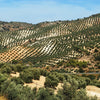
What most clients don't anticipate before arriving in Andalusia is the sheer scale of its landscape. The province of Jaén alone has over 60 million olive trees — more than any comparable territory on earth. Drive between Córdoba, Jaén, and Granada, and the sight is genuinely extraordinary: hundreds of kilometres of rolling hills covered in perfectly spaced olive trees, stretching to the horizon in every direction. Andalusia is almost certainly the most concentrated olive-growing landscape in the world, and it produces a significant share of the world's finest extra virgin olive oil. This is not background scenery — it is one of the great agricultural landscapes of Europe, and understanding it is as essential to understanding Andalusia as any cathedral or palace. When the light falls across those hills in the late afternoon, you will understand why this region has shaped so many artists, writers, and travelers who came here and never entirely left.
The route between Ronda and Málaga offers one of the most spectacular stops in all of Andalusia: the Caminito del Rey, a narrow walkway pinned to the vertical walls of the El Chorro gorge. Built a century ago to give workers access to a hydroelectric dam, it has since been fully restored and opened to the public — and walking it, with the gorge dropping away hundreds of metres on either side, is an experience unlike anything else in the region. We can arrange this as a planned stop on your Letango transfer, so what might otherwise be a straightforward drive becomes a half-day adventure you won't forget.
Traveling from Córdoba to Granada? We'll stop at a centuries-old winery in the Montilla-Moriles region for a guided vineyard tour and tasting of its exceptional fino and amontillado wines before continuing south to Granada. These intercity rides are, in my experience, some of the moments clients remember most.

Plan Your Andalusia with Letango
Andalusia is not a region you rush. It rewards the traveler who slows down, asks questions, and ventures beyond the obvious. Whether you're planning a week across Seville, Granada, and Córdoba, or want to combine the cities with the white villages and the Andalusian coast, Letango Tours designs every itinerary around your pace, your interests, and your time. Contact us to start planning your Andalusia experience — and let our local guides show you the region the way only insiders can.
Every article here reflects 25+ years on the ground—I've personally visited every destination, conducted the research, and taken these photos. AI helps us shape the writing and ensure clarity. The expertise? That's all mine.
- Carlos Galvin

Comments 0