
48 Hours in Siena: A Local's Guide to Tuscany's Rival City

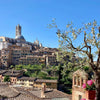
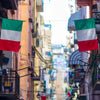
Ask a Sienese which neighborhood they belong to, and you'll get an answer as automatic as their name. Seventeen contrade divide this small hill town, and that loyalty — sworn young, worn on scarves, painted onto shop shutters — shapes almost everything a visitor notices here, right down to the colors in a ceramics shop window. Siena itself is barely a mile across; you could walk from one gate to the other in twenty minutes. But two days spent here, at the right pace, uncover a city most people driving through on a Tuscany itinerary never see: a library nobody photographs enough, a hospital turned museum that empties out while the cathedral line backs up outside, and a market where nobody is selling you anything meant for a suitcase.
At a Glance:
- Finding Your Bearings in the Campo
- Morning One: Santa Caterina's Streets and a Fountain Most Visitors Miss
- Afternoon One: Inside the Palazzo Pubblico
- The Wednesday Market at La Lizza and Siena's Ceramic Tradition
- Evening One: Where Siena Actually Eats
- Morning Two: Inside Siena's Duomo
- Afternoon Two: Santa Maria della Scala, Siena's Forgotten Hospital
- Planning Your 48 Hours in Siena
Finding Your Bearings in the Campo
Nine roads converge on Piazza del Campo, and that number is not decorative. The square's shell shape and its nine wedges of paving stone commemorate the Government of the Nine, the council of merchants who ruled Siena through its wealthiest century, the fourteenth, before the Black Death arrived in 1348 and cut the city's population by more than half. At the low point of the shell sits the Fonte Gaia, the fountain everyone photographs — though what you're looking at is a nineteenth-century copy. Keep that detail in your back pocket; it matters again on your second afternoon.
Twice a year, this same sloping brick oval becomes a racetrack. The Palio di Siena runs on July 2 and August 16, when ten of the city's seventeen contrade send jockeys riding bareback around the Campo's tight, banked curve for three laps that rarely take more than ninety seconds — a horse can cross the finish line and win with no rider at all, which tells you something about how this city measures victory. If your dates land anywhere near either race, expect the whole city to organize around it for days beforehand: trial runs at dawn, blessings of the horses inside each contrada's own church, and a square packed shoulder to shoulder well before the start.

Our guides who lead small groups through this square each week tend to start here for a reason: everything in Siena eventually points back to it, geographically and emotionally. It's the same arc our Siena Private Walking Tour follows, Duomo to Campo to a wine cellar finish, if you'd rather have a guide walk you through it first.
Morning One: Santa Caterina's Streets and a Fountain Most Visitors Miss
Start in the Oca contrada, downhill from the Duomo, at the Basilica of San Domenico. Its brick exterior is often as far as visitors get, but step inside and you'll find the reason this church matters to Siena: the mummified head of Santa Caterina, the city's patron saint and a Doctor of the Church, kept behind a grille in a chapel frescoed by Sodoma with scenes of her ecstasies. Her head was separated from her body by papal order in 1381 and carried here in procession in 1385 — a detail most guidebooks skip entirely. From the basilica, walk down toward Fontebranda, the medieval fountain fed by an underground spring that supplied this entire district for centuries; Caterina's family dye works stood a few steps from its arches, and the water still runs today. It's a five-minute detour that most tour buses never make.

Afternoon One: Inside the Palazzo Pubblico
The Torre del Mangia, the slender bell tower rising over the Campo, was built between 1338 and 1348 to reach exactly the same absolute height as the Duomo's own bell tower — the cathedral simply sits on higher ground. It was a deliberate message: church and civic power, equal. Inside the Palazzo Pubblico below it, the Sala dei Nove holds the reason this city still teaches art history students today, Ambrogio Lorenzetti's Allegory of Good and Bad Government, painted between 1338 and 1339 for the same council that shaped the Campo outside. Stand in front of the wall showing a well-governed Siena — market stalls, dancing, builders on rooftops — and you're looking at the same streets you just walked, painted seven centuries before you arrived. Ten euros gets you into the room; give it fifteen minutes, minimum.

This is exactly the kind of detail a private guide catches and a self-guided walk misses — the sort of thing we build every Letango itinerary around. Treat your first afternoon as orientation, then come back on your own to go deeper.
The Wednesday Market at La Lizza and Siena's Ceramic Tradition
If your two days include a Wednesday, build your morning around La Lizza, the open-air market that fills the gardens below the Medici fortress from 8:30 to 1:30. This is not a market styled for visitors — it's clothes, shoes, flowers, produce, and household goods, sold by the same families who've held these stalls for years, to neighbors doing their weekly shopping. It's the most authentic hour you'll spend in Siena, precisely because nothing about it was arranged for you. Afterward, walk to Via di Città 74, where Ceramiche Santa Caterina keeps alive a craft documented in Siena since 1265: hand-painted majolica in the copper green and manganese brown that mark true Sienese ceramics. Ask about contrada-crest pieces and you'll learn something unexpected — painting a district's colors legally requires authorization from the Consorzio per la Tutela del Palio, the body that still governs who may use those symbols.

Evening One: Where Siena Actually Eats
Skip whatever restaurant list your hotel prints out and start at Osteria Il Grattacielo, on Via dei Pontani, where there's barely room to sit. Most people stand at the marble counter with a glass of Chianti and a plate of cinta senese salami, pecorino, and pickled vegetables, the same way office workers and shopkeepers do on a break — it's the closest thing Siena has to a neighborhood bar, and eating this way tells you more about the city than any restaurant with an English menu ever will. For a proper sit-down dinner, walk to Antica Trattoria Papei in Piazza del Mercato, run by the same family since 1930 and recognized by Italy's Accademia Italiana della Cucina for keeping territorial cooking honest. Order the ossibuchi alla chiantigiana, braised veal shank in Chianti, or — if it's on the board that night — cinghiale in dolce e forte, wild boar braised in a sauce of vinegar, bitter chocolate, and pine nuts that traces back to Renaissance Tuscan kitchens and rarely shows up on a menu translated into English. Osteria di Via dei Rossi is another local favorite for it. Save one night for something more polished: La Taverna di San Giuseppe, in a cellar carved into third-century Etruscan rock beneath Via Giovanni Dupré, plates pici al ragù di cinghiale, and has held its place in the Michelin Guide for years — book ahead.
Save room for dessert, and buy it where Siena buys it: Nannini, on Via Banchi di Sopra, whose roots in the city's café culture trace to 1910. Try panforte Margherita — the lighter, sugar-dusted version invented in 1879 for a visit from Queen Margherita during the August Palio — alongside cavallucci, the dense honey biscuits Sienese travelers have carried on the road since the sixteenth century.

Morning Two: Inside Siena's Duomo
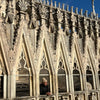
Everyone photographs the striped marble facade of the Duomo, and it deserves the attention: the lower tier's prophets and philosophers were carved by Giovanni Pisano between 1284 and 1297 — the originals now live in the cathedral's own museum, with copies standing in their place outside — while the upper half, heavier with mosaic and Gothic detail, went up decades later. It's what's inside that most visitors rush past, though. Michelangelo carved four statues for the Piccolomini altar, Peter, Paul, Pius, and Gregory, years before he ever touched the David, and they draw a fraction of the crowd his later work does. Donatello's gaunt bronze Saint John the Baptist stands in the left transept, one of his last works and a world away from the polished saints around it. In the north transept, look for the pulpit Nicola Pisano finished in 1268, a generation before his son took over the facade outside. And in the right transept, a small Baroque chapel by Gian Lorenzo Bernini — his only work in Siena, built as thanks for the city surviving the plague — feels like it wandered in from a different century entirely.

Fewer visitors still make it to the Piccolomini Library, tucked off the left aisle, where Cardinal Francesco Piccolomini — later Pope Pius III — commissioned Pinturicchio to fresco ten scenes from the life of his uncle, Pope Pius II, between 1503 and 1508. The colors are almost unfaded: gold leaf, ultramarine, crowds in period dress rendered in enough detail to identify individual faces, including, in one scene, a young Raphael. One more insider timing note worth knowing before you plan your trip: the cathedral's inlaid marble pavement, fifty-six panels built up over two centuries, is normally kept covered and protected. It's uncovered for public viewing only during set windows each year — in 2026, from June 27 to July 31 and again from August 18 to November 15 — so check the Duomo's current dates before you build your itinerary around it.

Afternoon Two: Santa Maria della Scala, Siena's Forgotten Hospital
Directly across from the Duomo sits a building most visitors photograph and skip: Santa Maria della Scala, a working hospital for pilgrims on the Via Francigena for nearly 800 years before it became a museum. Its Pellegrinaio hall holds frescoes painted around 1441 by Domenico di Bartolo and Lorenzo Vecchietta, showing hospital life in documentary detail — surgery, confession, orphaned infants being cared for — using perspective techniques ahead of what Florence was doing at the same moment. And here's where the Campo fountain comes back in: on the museum's lower level, you'll find the actual fifteenth-century Fonte Gaia marble panels Jacopo della Quercia carved in 1419, removed after a visitor climbing them during a Palio in 1743 fatally damaged one figure. What stands in the square today is Tito Sarrocchi's 1869 replica. The originals, worn but genuine, are here — usually with almost no one else in the room.
Afterward, walk two minutes to La Vecchia Latteria, a small gelateria near the Duomo making gelato fresh on-site, no line stretching down the block. It's the kind of stop our guides tell returning clients about rather than the kind you find searching “best gelato Siena” — worth the short detour before your two days end.

Planning Your 48 Hours in Siena
Siena works on foot; the historic center is compact enough that a taxi is rarely faster than walking. Base yourself inside or just outside the walls, keep your first afternoon loose for the Palazzo Pubblico and Campo, and save your second morning for the Duomo complex before tour groups arrive around ten. Two nights is the minimum we'd ever recommend for a city this layered — one night barely gets you past the highlights.
If Siena is one stop on a longer trip, our Rome & Tuscany Private Tour follows this same unhurried rhythm across central Italy, and our Italy private packages can be tailored around exactly this pace. Heading north afterward? Our 48 Hours in Milan guide takes the same approach. Ready to plan? Get in touch and we'll help you shape the rest of the trip.
Frequently Asked Questions About Siena
What are three experiences, foods, or cultural highlights I shouldn't miss in Siena?
Spend at least fifteen minutes in the Sala dei Nove inside the Palazzo Pubblico, standing in front of Lorenzetti's Allegory of Good and Bad Government — it's the single work that explains how this city saw itself. Order pici al ragù di cinghiale at a proper Sienese trattoria; it's the pasta this region built its reputation on. And if you're here on a Wednesday, walk through the La Lizza market before ten in the morning, when it's still mostly locals doing their weekly shopping.
What is the best time of year to visit Siena?
Late spring (May to June) and early fall (September to October) bring warm days, thinner crowds, and better restaurant availability than peak summer. If you want to witness the Palio horse race itself, plan around July 2 or August 16, but book accommodations many months ahead — the whole city fills for both races.
How many days should I spend in Siena?
Two full days lets you see the Duomo complex, the Palazzo Pubblico, San Domenico, and Santa Maria della Scala without rushing, plus time for a market morning and a proper sit-down dinner. We rarely recommend fewer than two nights here; a single day only allows for the exterior highlights.
Is Siena worth an overnight stay, or is it better as a day trip from Florence?
Siena rewards an overnight stay far more than a day trip. Most day-trippers see the Campo and the Duomo's facade and leave; staying two nights gets you into the museums and restaurants that only open up once the tour buses have gone home for the evening.
How do I get to Siena, and how do I get around once I'm there?
Siena is roughly ninety minutes from Florence by car or regional bus, with no direct high-speed rail line into the historic center. Once you're inside the walls, everything worth seeing is within a fifteen- to twenty-minute walk, so there's little need for a car or taxi in the center itself.
What should I know before visiting Siena's Duomo?
Entrance to the cathedral complex — including the Baptistery, the Crypt, and the Piccolomini Library — requires a combined pass, which is not included in most walking tours and is worth buying online in advance to skip the ticket line. The full marble pavement is only uncovered during set annual windows, so check current dates if seeing it is a priority.
What mistakes do visitors commonly make in Siena?
The most common mistake is treating Siena as a two-hour stop between Florence and the countryside, which means missing the Palazzo Pubblico interior and Santa Maria della Scala entirely. The second is skipping reservations at well-known trattorias like La Taverna di San Giuseppe, which fill up quickly even outside peak season.
Do you have any booking tips for a Siena visit?
Buy Duomo complex tickets online before you arrive rather than at the door, especially if traveling in summer. If you're adding an optional wine cellar tasting to a walking tour, note that it typically runs on a top-up card system rather than a fixed package, so you pay only for what you taste. If you'd like to time your visit — and a private tour with us — around the Palio itself, reach out well in advance, since availability during those two race weeks is limited and it's worth confirming details directly with our team
What should I pack for two days in Siena?
Comfortable, broken-in walking shoes are essential — the historic center is entirely stone and brick, much of it sloped or cobbled. Bring a layer for cool evenings even in summer, and shoulders and knees should be covered for any church visit, including the Duomo and San Domenico.
Is Siena a good destination for couples, solo travelers, or families?
Siena suits all three well. Couples find it romantic without being crowded like Florence, solo travelers will feel comfortable navigating its small, walkable center, and families appreciate that most sights are close together, with plenty of gelato stops built into any reasonable route.
Every article here reflects 25+ years on the ground—I've personally visited every destination, conducted the research, and taken these photos. AI helps us shape the writing and ensure clarity. The expertise? That's all mine.
- Carlos Galvin


Comments 0