
48 Hours in Naples: An Insider Guide to Italy’s Most Vibrant City

Naples has a reputation that precedes it, and for years I let that reputation do the thinking for me. Then a client asked me to design a Mediterranean itinerary that included the city, and I had to go back and look properly. What I found was a place that operates at a frequency entirely its own — louder, denser, more alive than almost anywhere I know. The key to enjoying it is the same key that works in every great city I have spent time in: slow down, eat where the locals eat, and accept that the most interesting things will not be on any list. This guide is built from those two days, and from every conversation I have had since with travelers who came back changed by the place.
At a Glance:
- The Archaeological Museum: Naples’s Greatest Treasure
- The Art of Neapolitan Pizza: Where and How to eat like a Local
- Centro Storico: Naples' Historic Heart
- Cappella Sansevero: The City's Most Extraordinary Secret
- The Real Naples: Craft, Markets and the City´s Living Trades
- Plan Your Mediterranean Journey with Letango
- FAQs: Your Naples Trip Questions Answered
The Archaeological Museum: Naples's Greatest Treasure
Begin Day 1 at the Naples National Archaeological Museum — and treat it as the main event, not the warm-up. This is one of the finest collections of Roman antiquity in the world, and it exists because of a geological accident: the eruption of Vesuvius in 79 AD preserved Pompeii and Herculaneum under ash and pumice with extraordinary completeness, and everything excavated from those cities over the past three centuries ended up here.
The mosaics from the Villa of the Faun are reason enough to visit — in particular the Alexander Mosaic, a work of such technical complexity and narrative power that standing in front of the original, after years of seeing it in books, is a genuinely disorienting experience. The Secret Room (the erotic art collection from Pompeii) requires a separate timed ticket and is worth the effort: it reframes the Roman world in ways that no academic description quite prepares you for.
My practical advice: arrive at opening time (9am), go directly to the mosaic rooms on the first floor before the school groups arrive, then work your way down. Allow a minimum of two hours; three is better. The museum's cafe is unremarkable — save your appetite for lunch.

The Art of Neapolitan Pizza: Where and How to Eat Like a Local
Neapolitan pizza is a protected designation of origin — the Associazione Verace Pizza Napoletana has been certifying authentic pizzerias since 1984 — and the difference between a certified margherita and everything else in the world is not subtle. It is the dough: long fermentation, high hydration, cooked in a wood-fired oven at 485°C for exactly 60 to 90 seconds. The result has a char, a chew, and a lightness that no imitation reproduces.
L'Antica Pizzeria da Michele on Via Cesare Sersale is the canonical address — founded in 1870, two options only (margherita or marinara), no frills, no reservations. Worth eating here once for the reference point. But the address I return to every time, and the one I give to every traveler who asks for something with genuine soul, is Pizzeria Imperatore 1906 on Via Duomo. The family has been in the gastronomy business in the San Lorenzo neighborhood for four generations — starting as a traditional charcuterie and evolving into the pizzeria and friggitoria it is today. Their signature creation, the Cappello di San Gennaro — a hat-shaped pizza filled with ricotta and provola, finished with Neapolitan ragú and meatballs — is unlike anything else in the city. The frittatine are extraordinary. The atmosphere is entirely local. This is the Naples that most visitors never find.
For dinner, Palazzo Petrucci offers a contemporary Neapolitan kitchen with views over the bay that justify every cent of the reservation. Book at least two weeks ahead. And if the Italian artisanal food tradition has captured your imagination, our Modena Aceto & Parmesan Experience takes that same philosophy of craft and patience into the heart of Emilia-Romagna.

Centro Storico: Naples' Historic Heart
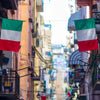
The afternoon of Day 1 is for getting properly lost in the Centro Storico — a UNESCO World Heritage district since 1995, and one of the densest, most alive historic centers in Europe. This is not a city that has been prettified for tourism. It is lived in, argued in, cooked in, and it will not slow down for you.
Spaccanapoli — the long straight street that literally splits the city in two, following the line of the ancient Greek decumanus inferior — is the spine of the neighborhood. Walk it from west to east and let the side streets pull you off course. On Via dei Tribunali, stop at the street-food counters for a frittatina di pasta or a cuoppo of fried things.
On the corner of Via Atri, look for the red cart of Da Cicciotto — the most famous limonata stand in Naples. The sign reads "a cosce aperte" (fresh-squeezed on the spot with Sorrento lemons). Have one. It costs next to nothing and tastes like the city in a glass.
The street art of the Quartieri Spagnoli deserves an hour of deliberate wandering. The murals of Maradona here are genuine acts of devotion. The most powerful depicts him with a golden halo, in the Napoli kit, as a Byzantine saint (artist: @jp_gimenez_dibujos). Nearby, a large mural signed @makergarcia shows a vintage woman's portrait — part of a wider tradition of figurative street art that has made this neighborhood an open-air gallery.
Before leaving, pass through the Galleria Umberto I — the iron-and-glass arcade built in 1890, steps from the Teatro San Carlo and Piazza del Plebiscito. End the day on the Lungomare — the seafront promenade — with a view of Castel dell'Ovo, the oldest castle in Naples.

Cappella Sansevero: The City's Most Extraordinary Secret
Begin Day 2 at the Cappella Sansevero — and go early, before 10am, when the space has the quiet it deserves. The chapel was commissioned in the 18th century by Raimondo di Sangro, Prince of Sansevero, a figure so eccentric and so brilliant that Naples has never quite decided whether to celebrate or fear his memory. He was an inventor, an alchemist, a Freemason, and a patron of art of extraordinary discernment.
The centerpiece is the Veiled Christ by Giuseppe Sanmartino, carved in 1753 from a single block of marble. The veil covering the figure is so convincingly translucent — every fold catching light as fabric would, the face of Christ visible beneath it with terrible clarity — that for over two centuries, visitors have refused to believe it was carved in stone. There is still a persistent legend that the veil was a real fabric, chemically petrified by the Prince using a lost alchemical process. It was not. But the legend persists because the alternative — that a 26-year-old sculptor simply did this with a chisel — is equally impossible to accept.
Also in the chapel: the Disillusionment (a figure trapped in a marble net of equal virtuosity), and in the basement, the Prince's anatomical machines — two human skeletons with their circulatory systems preserved in minute detail, the method of preservation still unexplained. Book tickets at least two to three weeks ahead in peak season. The chapel is tiny; capacity is strictly limited.
The Real Naples: Craft, Markets and the City's Living Trades
Dedicate the afternoon of Day 2 to the parts of Naples that most tourists never reach. Start on Via San Gregorio Armeno — the Christmas Alley — where family-run workshops have been producing hand-painted terracotta figures for over 400 years, and what happens inside the best of them is genuine craft, not souvenir production. Each figure is modeled in clay, fired, painted by hand, and finished with fabric and wire by artisans who learned their trade from their parents, who learned it from theirs. The range is extraordinary: the traditional biblical cast sits alongside contemporary figures — politicians, footballers, celebrities — updated every year with a deadpan wit that is entirely Neapolitan. Ask to see inside a workshop if you can; the craftspeople, if approached with genuine curiosity, will show you the moulds, the unpainted figures, the stages of production that the finished pieces conceal.
A short distance south of Naples, the town of Torre del Greco has been the world capital of coral jewelry since the 18th century. The red coral of the Mediterranean, harvested from the seabed at depths of up to 300 meters, is worked here by hand into brooches, necklaces, and cameos of remarkable quality — objects with a story and a provenance that no industrial process can replicate. Worth knowing about, and worth a detour if your clients collect things that last.
Between the workshops and the coral, I always steer travelers toward La Pignasecca — Naples's oldest working market, tucked just off Via Toledo. This is not a food-tour stop; it is where Neapolitans actually shop. The fishmongers shout the morning's catch, the vegetable stalls pile up what is in season, and the friggitorie sell fried anchovies, zucchini flowers and potato croquettes in paper cones for a couple of euros. Walk slowly. Order what the person ahead of you just ordered. Eat standing up. This is how Naples feeds itself every day, and no guided visit will ever replicate the texture of it.
A few minutes north, the Duomo di Napoli deserves a short deliberate stop — not the whole cathedral, but the Royal Chapel of the Treasure of San Gennaro. Gennaro is the patron saint of the city, and the chapel holds a vial of his blood that, according to centuries of tradition, liquefies three times a year. Believe what you want about the chemistry; what matters is that the event still stops the city. The chapel itself, designed between 1608 and 1637 and dedicated after the plague of 1526, contains one of the most important collections of Baroque goldsmithing in Europe — silver reliquaries, processional crosses and mitres so encrusted with gems that they read as objects from a different civilization.
Before leaving the Centro Storico, stop for a sfogliatella at one of the historic pastry counters on Via dei Tribunali — served hot, with a caffè napoletano alongside, shorter and more concentrated than any espresso you will have drunk elsewhere, served with a small glass of water that the Neapolitans drink first to clean the palate.
End the afternoon at Posillipo Hill — by taxi, arriving 30 minutes before sunset — with a view of the bay, Vesuvius across the water, and the city's lights beginning to come on below. There is no better place to understand what Naples is, and why it stays with you.

Plan Your Mediterranean Journey with Letango
Naples is extraordinary, and it is rarely just a destination in itself — it is usually the beginning of something larger. Whether you want to continue south into Puglia and the heel of Italy, north to Rome and Tuscany, or across to Spain for a completely different register of history and culture, the journey can be designed around your pace and your interests.
Our Mediterranean Italy 10-Day Escape combines Naples, Sorrento and Puglia into one of the most satisfying itineraries we offer — the south of Italy at its most complete. For a fully bespoke multi-day journey, explore our Italy Private Packages and we will build the itinerary around you. And if your next Italian city is Milan, our 48 Hours in Milan guide will be available soon — a curated itinerary for Italy's most design-forward city.
Ready to make it happen? Contact us, and we'll take care of every detail!
FAQs: Your Naples Trip Questions Answered
When is the best time to visit Naples?
How far in advance should I book Cappella Sansevero tickets?
Do I need to book the Naples Archaeological Museum in advance?
How do I avoid the queues at L'Antica Pizzeria da Michele?
How do I get from Naples to Pompeii?
What is the best neighborhood to stay in for 48 hours?
Is Naples safe for tourists?
Can I visit Pompeii and Herculaneum as a day trip from Naples?
Is Via San Gregorio Armeno only worth visiting at Christmas?
What are three experiences, foods, or cultural highlights I shouldn't miss in Naples?
One unmissable experience: watching the sunset from Posillipo Hill with Vesuvius across the bay. One food: a margherita at Pizzeria Imperatore 1906 followed by a sfogliatella and a caffè napoletano on Via dei Tribunali. One cultural moment: standing in front of the Veiled Christ at Cappella Sansevero early in the morning, when the chapel is quiet. Together, these three give you Naples in concentrate.
Every article here reflects 25+ years on the ground—I've personally visited every destination, conducted the research, and taken these photos. AI helps us shape the writing and ensure clarity. The expertise? That's all mine.
- Carlos Galvin






Comments 0