
Cervantes in Madrid: Walking the Streets That Shaped Don Quixote

There is a bar on Calle Huertas that has been open since 1827. Zinc counter, barrels of house vermouth, croquetas that haven't changed in decades. On the facade, a plaque notes what stood here before: a house where Miguel de Cervantes once lived and wrote. Most people walk past it without stopping. A few pause, read the plaque, and move on. Almost nobody asks what Cervantes was working on when he lived here, why he moved addresses so often, or what his daily life in this neighborhood actually looked like.
That gap — between the famous name on the plaque and the human being behind it — is what I spend three hours closing, every time I walk this neighborhood with a client. In the early seventeenth century, within a few cobblestoned blocks of each other, lived Cervantes, Lope de Vega, Quevedo, and Góngora — arguably the greatest concentration of literary talent in the history of the Spanish language. The streets haven't forgotten. If you're planning a trip to Madrid and want to understand what makes this city different from every other European capital, join us on our Madrid Cervantes Private Walking Tour.

At a Glance:
- Who Was Cervantes — and Why Does He Still Matter?
- The Book That Changed Everything
- The Barrio de las Letras: A Literary Quarter You Can Still Walk
- Cervantes in Madrid: The Man Behind the Plaque
- Planning Your Visit
- Frequently Asked Questions
Who Was Cervantes — and Why Does He Still Matter?
Miguel de Cervantes Saavedra was born in Alcalá de Henares in 1547, but Madrid was where his story ended — and where his greatest work was born. His life before arriving here reads like a picaresque novel: soldier at the Battle of Lepanto, where he lost the use of his left hand; prisoner of Ottoman corsairs in Algiers for five years; tax collector for the Spanish Armada; briefly jailed in Seville on embezzlement accusations that were probably unjust. By the time he settled in the neighborhood now named after the literary world he helped create, he was past sixty, in poor health, and perpetually short of money.
He was also, quietly, producing work that would outlast every king and empire his generation had known. The first part of Don Quixote appeared in 1605. The second — widely considered the greater achievement — in 1615, the year before his death. Between those two volumes, Cervantes invented something the literary world had not quite seen before: a novel that knows it is a novel, a hero who is ridiculous and magnificent at once, a Spain rendered with irony and tenderness in equal measure. Four hundred years later, it remains the most translated book in history after the Bible.

The Book That Changed Everything
The physical address where Don Quixote first entered the world is still there. On Calle Atocha, the Sociedad Cervantina stands on the exact site of Juan de la Cuesta's printing house, where the first edition was typeset and pressed in 1604 and 1605. The society has reconstructed a working replica of the original press — the kind of heavy wooden machine that would have produced roughly 1,800 copies of that first run, hand-set letter by letter in a small workshop on a busy Madrid street.
Think about what that means for a moment. A book that would eventually be translated into more than fifty languages, read by several hundred million people, and declared by a poll of international writers the greatest novel ever written — it began in this building, in this city, in a first print run smaller than a local newspaper's morning delivery. The Sociedad Cervantina is one of the places I bring every client who loves literature. Most of them stand in front of the press longer than they expect to.
To understand what Cervantes was really doing with Don Quixote, it helps to stand in front of the Iglesia de Santiago in Madrid — the church that marks the starting point of the city's Camino de Santiago, and whose interior holds a painting of Santiago on horseback at the Battle of Clavijo, completed just decades after Cervantes' death. The image says everything about the world his novel was interrogating. The military orders — Santiago, Calatrava, Alcántara — were the living embodiment of the chivalric ideal in seventeenth-century Spain: honor, lineage, the sword in service of faith. Membership was among the most coveted distinctions a man could hold, and the code they represented had shaped Spanish identity for five centuries. Cervantes knew that world intimately, from the inside and from the outside. Don Quixote is not simply a parody of knightly novels. It is a book that asks, with equal measures of affection and irony, what happens to a society that cannot let go of an ideal whose time has passed. By the mid-seventeenth century, historians note, the prestige of the Order of Santiago had begun to wane — practical administration overtaking symbolic gesture. Cervantes had seen it coming forty years earlier, from a cramped house on a cobblestoned street in Madrid.
If you want to experience this neighborhood the way it deserves — with the stories behind every stop, the literary rivalries, the hidden details that no guidebook covers — our private Cervantes walking tour covers the printing house, the tavern on Huertas, the church where his funeral was held, and the corner where he spent his final years, in three hours that feel nothing like a lecture.

The Barrio de las Letras: A Literary Quarter You Can Still Walk
The Barrio de las Letras — the Letters Quarter — sits between the Paseo del Prado and the Puerta del Sol, roughly bounded by Calle Atocha to the east and Carrera de San Jerónimo to the north. It is a neighborhood of narrow streets, corner taverns, and buildings that mostly date from the eighteenth and nineteenth centuries, built on foundations that go back much further. Walk it on a weekday morning and you get something close to what it must have felt like when it was the center of Madrid's creative world. If you're thinking about how to fit it into a broader stay, our 48 hours in Madrid guide is a good place to start.
The most remarkable detail is embedded in the pavement itself. Along Calle Huertas, lines of verse and prose from the great Golden Age writers — Cervantes, Lope de Vega, Quevedo, Góngora — are set in bronze letters directly into the cobblestones. You walk over their words. It sounds like a tourist gimmick; it isn't. The selection is serious, the typography elegant, and the effect of reading a fragment of Don Quixote pressed into the street where Cervantes himself walked is genuinely strange and moving.
What made this concentration of talent possible was simple economics: writers in Golden Age Madrid needed patrons, publishers, theaters, and each other. The neighborhood had all of it within walking distance. It also had something that mattered to working writers in the seventeenth century — dozens of cheap taverns, many of which doubled as the informal offices where deals were made, feuds were started, and plays were read aloud before they reached the stage. The literary rivalries here were spectacular. Cervantes and Lope de Vega despised each other for decades. Quevedo wrote savage satires about almost everyone. The Barrio de las Letras was never a quiet place.

Cervantes in Madrid: The Man Behind the Plaque
What strikes me every time I walk this neighborhood is how much it holds. The Barrio de las Letras looks modest from the outside — narrow streets, old facades, nothing that announces itself as significant. But almost every corner here carries a story connected to Cervantes, and the stories are never simple. A tavern that has been on the same spot since 1827. The Convento de las Trinitarias, whose residents sheltered his remains for nearly four centuries without knowing exactly where they were. A street where his greatest rival lived close enough that they almost certainly crossed paths on a regular basis, and chose not to speak.
What we know about how Cervantes spent his days in this neighborhood is fragmentary but specific enough to be vivid. He frequented the mentideros — the informal gossip corners where writers, actors, booksellers, and theater people gathered to argue, deal, and hear what the court was saying. There was one near San Felipe el Real, another on Calle del León, a few streets from where he lived. These were not literary salons. They were loud, crowded, and occasionally dangerous — the kind of places where a satirical poem about the wrong person could end a career or start a duel. Cervantes knew all of them, and they fed directly into everything he wrote.
His relationship with Lope de Vega — who lived a short walk away on what is now Calle Cervantes, a street that carries his enemy's name rather than his own — was one of the great literary feuds of European history. Lope was famous, wealthy, endlessly productive, and insufferable about it. Cervantes was older, and writing something that Lope never fully understood. They took shots at each other for decades in print. Both men knew exactly where the other lived. The neighborhood was too small for either of them to pretend otherwise.
By the time Cervantes finished the second part of Don Quixote — the one that most readers consider the greater achievement — he was sixty-seven, sick, and writing in the same cramped rooms on Calle León where he would die ten months later. He finished Persiles y Sigismunda four days before his death, dictating the dedication from his sickbed. The man who invented the modern novel did not stop writing until he physically couldn't.
There are details in this neighborhood that bring all of that into focus — the kind of details that don't appear on plaques; is where those stories live.

Planning Your Visit
Madrid's Barrio de las Letras is at its best in the morning, before the lunch crowds arrive on Calle Huertas. The neighborhood is entirely walkable — the distances between the key Cervantes sites are small, and getting lost here is not a problem. Most of the exteriors and plaques can be seen without booking anything in advance; the Sociedad Cervantina's workshop visits are the one exception worth planning around.
If you are building a Madrid trip around literature, the Hemingway connection runs through an entirely different part of the city — the Gran Vía cafés, the Chicote bar, the streets around the Puerta del Sol — and makes a natural companion to a morning in the Barrio de las Letras. Our Hemingway Madrid tour and our Hemingway in Madrid guide cover that world in the same depth.
Madrid has more than one literary neighborhood, and more than one story worth following. If you're planning a longer stay, our Madrid private walking tours show the full range of what's possible.
When you are ready to talk about your trip specifically, Contact us. Tell us what draws you to Madrid — the art, the food, the history, the literature — and we'll build something around it.
Frequently Asked Questions
Where can I see Cervantes' most important works in person?
Cervantes was a writer, not a visual artist, so his "works" exist in editions rather than objects — but you can stand in front of a working replica of the press that produced the first edition of Don Quixote at the Sociedad Cervantina on Calle Atocha. The Biblioteca Nacional on Paseo de Recoletos holds rare early editions of his works in its collection. For the manuscript culture of the Golden Age more broadly, the Biblioteca Nacional's permanent exhibition is genuinely excellent.
Is there a specific place in Madrid where I can still feel Cervantes' presence today?
The corner of Calle León and what was once Calle Francos, where he spent his final years, is surprisingly affecting for what is essentially a modern street corner with a modest plaque. The Convento de las Trinitarias on Calle Lope de Vega — where his remains rest — carries more weight. But for me, the place where Cervantes feels most present is the stretch of Calle Huertas where his words are literally pressed into the cobblestones. That detail, more than any statue or plaque, connects the writing to the city.
What are three things I shouldn't miss in Madrid's literary quarter?
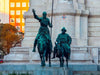
The bronze verse on Calle Huertas read slowly, in morning light — not just glanced at while walking. A glass of house vermouth at a bar that has been on this street since the nineteenth century, which is an experience as much as a drink. And the story behind the Cervantes statue in Plaza de las Cortes — the part that almost nobody knows — which I'll leave for your guide to tell.
What is the best time of year to visit Madrid and the Barrio de las Letras?
Spring (April through early June) and autumn (September through November) are the most comfortable for walking: mild temperatures, manageable crowds, and the neighborhood at its most lived-in. July and August are hot and humid, though the mornings are still pleasant and the city is quieter than you might expect — many Madrileños leave in August. Winter is underrated: the light in the Prado is extraordinary, the tabernas on Calle Huertas are warm and full of locals, and there are no queues.
How many days should I spend in Madrid?
Three nights is the minimum to do the city justice without feeling rushed. Four or five gives you the Prado and the Reina Sofía properly, a half-day in the Barrio de las Letras, an evening in La Latina, and enough time to eat well without scheduling every meal. If you are combining Madrid with another Spanish city — Seville, Granada, San Sebastián — a week for both is comfortable, two is better.
Did Cervantes and Shakespeare really die on the same day?
They died within days of each other in April 1616 — but not on the same date, despite the often-repeated claim. England had not yet adopted the Gregorian calendar, so April 23, 1616 in England corresponded to May 3 in Spain. Cervantes died on April 22 (Spanish calendar); Shakespeare on April 23 (English). The coincidence is still remarkable — the two greatest writers of their era, gone within weeks of each other — but they almost certainly never knew the other existed, and the "same day" story is a calendar artifact.
How do I get to the Barrio de las Letras from central Madrid?
The neighborhood is walkable from almost everywhere in central Madrid. From Puerta del Sol it's roughly ten minutes on foot south along Carrera de San Jerónimo. The nearest Metro stops are Antón Martín (Line 1) and Sevilla (Line 2). Taxis and Uber are straightforward from anywhere in the city; if your hotel is near Gran Vía or the Prado, the walk is part of the experience.
What common mistakes do visitors make in the Barrio de las Letras?
Arriving for lunch on Calle Huertas when the street is at its noisiest and most tourist-facing, and concluding that this is all the neighborhood has to offer. Going straight to the busiest bar with the longest queue, rather than one of the older tabernas a block off the main street. Missing the Convento de las Trinitarias because it looks closed — it is closed to general visitors, but the plaque and the story are there. And walking down Calle Huertas without looking at the cobblestones.
Can the Cervantes walking tour be combined with a museum visit?
Yes, and it works well. The tour ends near Gran Vía, which puts you within easy walking distance of the Prado, the Reina Sofía, and the Thyssen-Bornemisza — three of the great art museums in Europe, each a different kind of experience. I usually suggest doing the walk in the morning and spending the afternoon in whichever museum matches your interests. If it's Velázquez and the Spanish masters, go to the Prado. If it's Picasso's Guernica and twentieth-century Spanish art, the Reina Sofía.
Is the Cervantes walking tour suitable for families with teenagers?
Yes, particularly for teenagers who have read — or are about to read — Don Quixote in school. The tour works best when the material means something to the people doing it, and walking the actual streets where the book was written, standing in front of the press where it was printed, has a very different effect than reading about it in a classroom. The pace is entirely yours; there are no entrance tickets required, and the stories your guide carries are genuinely engaging rather than textbook-dry.
Every article here reflects 25+ years on the ground—I've personally visited every destination, conducted the research, and taken these photos. AI helps us shape the writing and ensure clarity. The expertise? That's all mine.
- Carlos Galvin

Comments 0